skateboard adalah sebuah
papan yang memiliki empat
roda
dan digunakan untuk aktivitas meluncur. Papan ini memiliki tenaga yang
dipacu dengan mendorong menggunakan satu kaki sementara kaki yang
satunya berada di atas papan. Bisa juga sang pengguna berdiri di atasnya
sementara papan ini meluncur ke bawah pada sebuah turunan yang curam
dan dengan ini menggunakan gaya
gravitasi sebagai pemacu.
A
skateboard is a type of
sports equipment used primarily for the activity of
skateboarding. It usually consists of a specially designed
maple wood board combined with a polyurethane coating used for making smoother slides and stronger durability.
A skateboard is propelled by pushing with one foot while the other remains on the board, or by
pumping one's legs in structures such as a pool or
half pipe.
A skateboard can also be used by simply standing on the deck while on a
downward slope and allowing gravity to propel the board and rider. If
the rider positions their right foot forward, he/she is said to ride "
goofy"; if the rider positions their left foot forward, he/she is said to ride "
regular". If the rider is normally regular but chooses to ride goofy, he/she is said to be riding in "switch",
and vice versa. A skater is typically more comfortable pushing with
their back foot; choosing to push with the front foot is commonly
referred to as riding "mongo."
Recently,
electric skateboards
have also appeared. These no longer require the propelling of the
skateboard by means of the feet; rather an electric motor propels the
board, fed by an electric battery.
There is no governing body that declares any regulations on what
constitutes a skateboard or the parts from which it is assembled.
Historically, the skateboard has conformed both to contemporary trends
and to the ever evolving array of stunts performed by riders/users, who
require a certain functionality from the board. Of course, the board
shape depends largely upon its desired function.
Longboards are a type of skateboard with a longer
wheelbase and larger, softer wheels.
Skateboards have 3 axes. The tail axis (running from nose to tail),
the central axis (running straight down through the center of the
board), and the short axis (running from the width of the board,
perpendicular to the tail axis).
The two main types of skateboards are the longboard and the
shortboard. The shape of the board is also important, the skateboard
must be concave to perform difficult tricks.
Parts
Descriptions of the following skateboard parts are the ones most
prevalent in popular, modern forms of skateboarding. Many parts exist
with exotic or alternative constructions. Most decks are constructed
with a six to seven-plywood, the deck, trucks, wheels, bearings,
hardware, bushings and griptape.
Deck

The underside of a skateboard
Modern decks vary in size, but most are 7 to 10.5 inches (17.78 to
26.67 centimeters) wide. Wider decks can be used for greater stability
when transition or ramp skating. Skateboard decks are usually between 28
and 33 inches (71.12 and 83.82 centimetres) long. The underside of the
deck can be printed with a design by the manufacturer, blank, or
decorated by any other means.
The
longboard,
a common variant of the skateboard, has a longer deck. This is mostly
ridden down hills or by the beach to represent the riding of a wave in
the ocean on a
surfboard.
This was created by two surfers; Ben Whatson and Jonny Drapper. One of
the first deck companies was called "Drapped" taken from Jonny's second
name. "Old school" boards (those made in the 1970s–80s or modern boards
that mimic their shape) are generally wider and often have only one
kicktail. Variants of the 1970s often have little or no concavity,
whereas 1980s models have deeper concavities and steeper kicktails.
[citation needed]
Grip tape,
when applied to the top surface of a skateboard, gives a skater's feet
grip on the deck. It is most often black but can come in a variety of
colors including clear, allowing the top of the deck to be decorated. It
has an adhesive back and a sandpaper-like top.
Trucks
Attached to the deck are two metal (usually aluminum alloy) trucks,
which connect to the wheels and deck. The trucks are further composed of
two parts. The top part of the truck is screwed to the deck and is
called the baseplate, and beneath it is the hanger. The axle runs
through the hanger. Between the baseplate and the hanger are
bushings, also
rubbers or
grommets, that provide the cushion mechanism for turning the skateboard. The
bushings
cushion the truck when it turns. The stiffer the bushings, the more
resistant the skateboard is to turning. The softer the bushings, the
easier it is to turn. A bolt called a
kingpin
holds these parts together and fits inside the bushings. Thus by
tightening or loosening the kingpin nut, the trucks can be adjusted
loosely for better turning and tighter for more stability. Standard
Kingpin nut size is 3/8" - 24tpi.
Skateboard trucks are manufactured in a number of different axle
widths. In general an axle width should be chosen that is close to the
width of the deck it will be used with.
[2]
For example, a 7.75" wide deck will usually be fitted with trucks that
have axles between 7.5" wide and 8.0" wide. (Standard truck axel nut
size is 5/16"-24tpi UNF, and the thinner "jam" style with an optional
nylon lock.) Trucks that are too wide can make doing tricks difficult
and can cause the wheels to get in the way when the skateboard is being
ridden. Trucks that are too small can be hard to maintain stability and
can cause wheel bite to occur when turning.
Longboard specific trucks are a more recent development. A longboard
truck has the king pin laid at a more obtuse angle (usually between 38
and 50 degrees
[3])
to the deck, this gives a greater degree of turning for the same tilt
of the deck. This allows riders to go much faster while still
maintaining stability and control.
Giant strides have been made in the truck industry over the years. In
late 2007, Gullwing Truck Company manufactured a truck named
"Sidewinder" that can pivot on two different angles, thus greatly
decreasing the turning radius of the board, resulting in a greater feel
between the rider and the sidewalk.
Wheels
The wheels of a skateboard, usually made of
polyurethane,
come in many different sizes and shapes to suit different types of
skating. Larger sizes like 54–85 mm roll faster, and also move more
easily over cracks in pavement. Smaller sizes like 48–54 mm keep the
board closer to the ground, require less force to accelerate and produce
a lower center of gravity, but also make for a slower top speed. Wheels
also are available in a variety of hardnesses usually measured on the
Shore durometer
"A" scale. Wheels range from the very soft (about Shore A 75) to the
very hard (about Shore A 101). As the A scale stops at 100, any wheels
labeled 101A or higher are harder, but do not use the appropriate
durometer scale. Some wheel manufacturers now use the "B" or "D" scales,
which have a larger and more accurate range of hardness. Modern street
skaters prefer smaller wheels (usually 51–54 mm), as small wheels with
lighter trucks can make
tricks like
kickflips
and other flip tricks easier by keeping the center of gravity of the
skateboard closer to the deck, thus making the deck easier to spin.
Street wheels are softer.
Vertical ramp
or "vert" skating requires larger wheels (usually 55–65 mm), as it
involves higher speeds. Vert wheels are also usually harder, allowing
them to maintain high speed on ramps without sliding. Slalom skating
requires even larger wheels (60–75 mm) to sustain the highest speeds
possible. They also need to be soft and have better grip to make the
tight and frequent turns in slalom racing. Even larger wheels are used
in longboarding and downhill skateboarding. Sizes range from 65 mm to
100 mm. These extreme sizes of wheels almost always have cores of hard
plastic that can be made thinner and lighter than a solid polyurethane
wheel. They are often used by skateboard videographers as well, as the
large soft wheels allow for smooth and easy movement over any terrain.
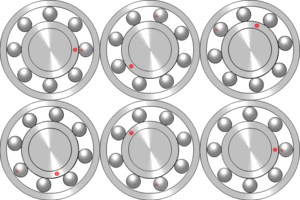
An Animation of the working principle for a
ball bearing.
N.B. The diagram shows an 8-balled-bearing whereas a skateboard bearing is typically 7-balled
Grip tape
Grip tape is a sheet paper or fabric with adhesive on one side and a
surface similar to fine sand paper on the other. Grip tape is applied to
the top surface of a board to allow the rider's feet to grip the
surface and help the skater stay on the board while doing tricks. Grip
tape is usually black, but is also available in many different colors
such as pink, yellow, checkered, camo, and even clear. Often, they have
designs die-cut to show the color of the board, or to display the
board's company logo.
Bearings
Each skateboard wheel is mounted on its axle via two
bearings.
With few exceptions, the bearings are the industrial standard "608"
size, with a bore of 8 mm, an outer diameter of 22 mm, and a width of
7 mm. These are usually made of steel, though silicon nitride, a
high-tech ceramic, is sometimes used. Many skateboard bearings are
graded according to the
ABEC scale.
The scale starts with ABEC1 as the lowest, 3, 5, 7, 9. It is a common
misconception that the higher ABECs are better for skateboarding, as the
ABEC rating only measures
tolerances,
which do not necessarily apply to skateboards. Bearing performance is
determined on how well maintained the bearings are. Maintenance on
bearings include periodically cleaning and lubricating them
[1].
Bearings that are kept unmaintained have their performance greatly
lowered and will soon need to be replaced. Bearing cleaning kits are
commonly available on the market. Example kits include the Bones
Bearings Cleaning Unit
[2]. The ABEC rating does not determine how fast or how durable a bearing used for skateboarding will be.
[4]
In particular, the ABEC rating says nothing about how well a bearing
handles axial (side-to-side) loads, which are severe in most skateboard
applications. Many companies do not show the ABEC rating, such as
Bones Bearings,
which makes bearings specifically for skateboarding, often marketed as
"Skate Rated". Each bearing usually contains 7 steel or ceramic
ball bearings, although other configurations are used as well.
Hardware
Mounting hardware is a set of eight 10-32
UNC bolts, usually an
Allen or
Phillips head, and matching nylon
locknuts.
They are used to attach the trucks to the board. Some sets have one
different colored bolt to show which side is the nose of the skateboard.
Hardware is available in various lengths for mounting trucks with or
without risers.


